Ultraviolet sterilization and disinfection lamp is a device with a low-pressure mercury lamp that can emit ultraviolet rays. Low-pressure mercury lamps are excited by low mercury vapor pressure (<10-2Pa) to emit ultraviolet rays. The wavelength ranges from 10 ~ 400nm. The peak wavelength of the lamp is 253.7nm, and its power ranges from 4W to 100W. In addition, with today's LED technology, LEDs can also be produced for UV lamps. It is mainly used for disinfection, sterilization, and air purification. It is also used in the printing and dyeing industry to dry UV-based ink after printing.
UV rays cause photolysis and denaturation of bacterial proteins, disrupting their cellular activities and rendering them inactive.
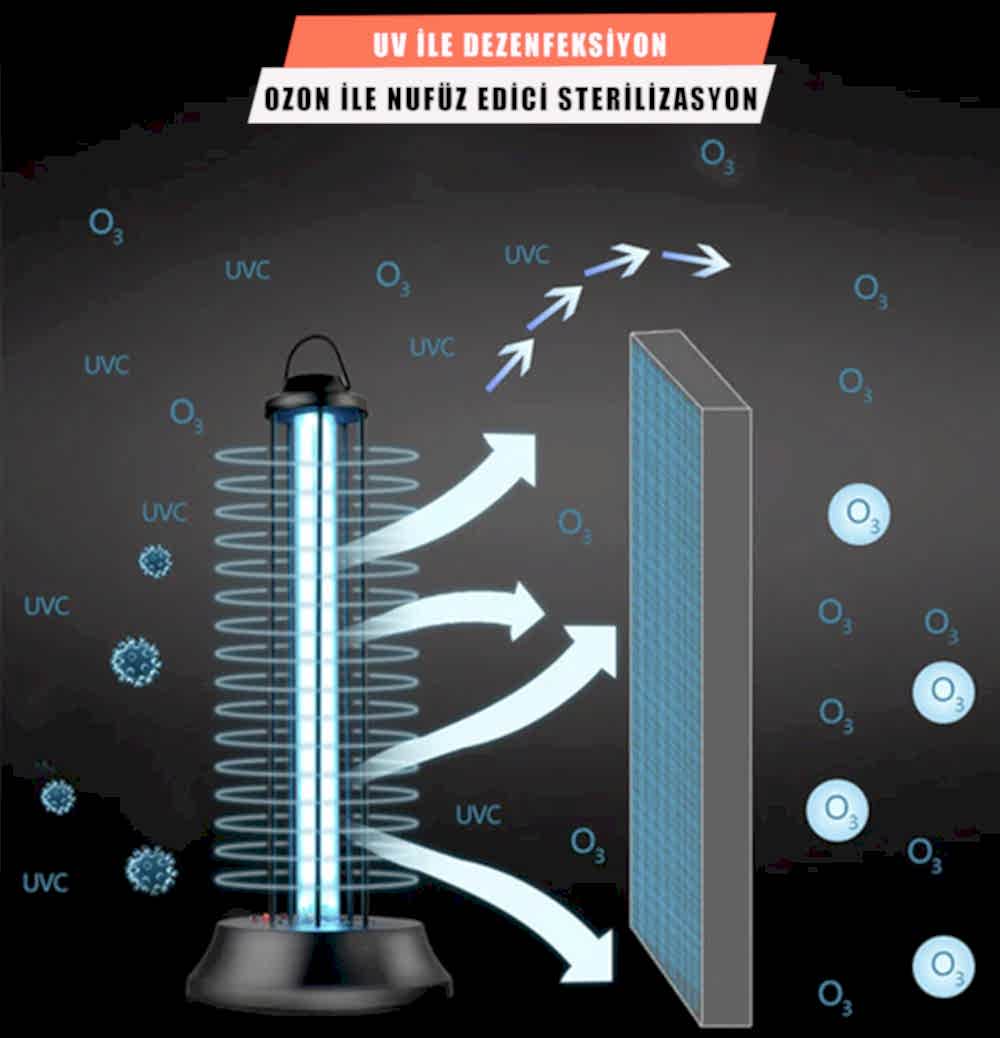
At the same time, when ultraviolet rays (of a certain wavelength) pass through the air, the oxygen in the air is ionized to produce ozone, which increases the sterilization effect.
Ionization: When ultraviolet rays are emitted, irregular ions are formed around the rays, allowing oxygen molecules in the air to be ionized and reassembled with ozone.
There are two main spectral lines: one with a wavelength of 253.7nm (254nm) and the other with a wavelength of 185nm, both of which are invisible to the naked eye. Among them, 253.7nm is ozone-free ultraviolet rays, and 254nm ultraviolet rays kill bacteria by destroying the DNA of microorganisms; 185nm is the ozone band of ultraviolet rays, and the 185nm wavelength can ionize the air to produce ozone (185nm ultraviolet can convert O2 in the air to O3).
Ozone + 185nm short-wave ultraviolet rays not only destroy DNA by irradiating bacteria but also ionize oxygen in the air to produce ozone, killing bacteria. So, it has a dual sterilization effect.
| FEATURE | OZONE-FREE | OZONE-GENERATING |
| Disinfection Principle | Wavelength 254nm | Wavelength 185nm + Ozone |
| Disinfection Feature | Disinfects the area it irradiates | Reaches hidden spots. Has penetrating power |
| Environment of Use | Places with no clutter or walls | Places with high clutter and hidden spots |
| Functional Features | Disinfection, sterilization, mite removal, no residue or traces | Disinfection, sterilization, mite and formaldehyde removal, strong ozone smell |
Advantages: Ozone has a strong oxidizing effect that can effectively kill bacteria and eliminate mites. Due to ozone's dispersibility, it can also reach areas that ultraviolet rays, which travel in straight lines, cannot reach, covering hidden areas.
Disadvantages: Excessive ozone is an invisible killer! It strongly stimulates the respiratory tract, causing throat irritation, chest tightness, coughing, bronchitis, and emphysema. After disinfection, you need to open the windows for ventilation.
It requires long ventilation time.
Advantages: Disinfection, mite removal features, and you can enter the room immediately after sterilization. The ventilation time is short.
Disadvantages: It only spreads in a linear fashion and has a linear effect. Hidden spots may form, leading to incomplete disinfection.
Ozone itself has an odor. After using the ultraviolet + ozone disinfection lamp, there will be a smell in the air. Therefore, for certain situations, it may not be suitable for use, such as restaurants, hotels, clubs, etc.
A high ozone concentration environment can have adverse effects on the human body. Since ozone increases hemoglobin coagulation in the human body, it can lead to insufficient oxygen, dizziness, and nausea, affecting health. Particularly, when ozone concentration > 0.3ppm (mg/m2), it causes serious damage. Therefore, ozone lamps are generally not allowed in places with frequent personnel activity.
Ozone has an unstable structure and decomposes easily. The higher the temperature, the faster the decomposition. Ozone in the air is usually reduced to oxygen within 30 minutes at room temperature. After sterilization, it is recommended to immediately ventilate the area to exhaust the ozone before it decomposes.
The average lifespan of UV lamps is 8000 hours, and they can be used for up to 2 years. Additionally, the usage time should be meticulously tracked to monitor the disinfection function of the lamp.
The application should be done in an environment without humans or other living creatures, including pets.
| CHEMICAL INDUSTRY, PLASTICS AND RUBBER | LUX | SERVICE INDUSTRIES | LUX | ||
| Remote Controlled Factories | 50 | Hotels and Food Services | 200 | ||
| Processes Requiring Human Support | 100 | Receptions | 500 | ||
| Factories with Continuous Human Workstations | 200 | Restaurants | 200 | ||
| Control and Monitoring Points | 300 | Buffets | 300 | ||
| Laboratories, Packaging Areas | 300 | Conference Rooms | 300 | ||
| Jobs Requiring Visual Concentration | 500 | Self-Service Facilities | 300 | ||
| Color Controls | 1000 | Cafeterias | 200 | ||
| Rest Rooms | 100 | ||||
| CEMENT INDUSTRY, CERAMICS AND GLASS | LUX | Recreation Rooms | 300 | ||
| Ovens, Mixers, and Brick Processing Workstations | 200 | Showers, Toilets, and Changing Rooms | 100 | ||
| Grinding, Polishing, Complex Parts Molding | 300 | First Aid and Medical Rooms | 500 | ||
| Enamel Coating, Rolling, Pressing, Casting | 500 | ||||
| Lens Cutting, Glass Cutting, Medium Precision Tasks | 750 | WAREHOUSES AND STORAGE | LUX | ||
| Very Fine Tasks | 1000 | Ovens, Mixers, and Brick Processing Workstations | 200 | ||
| Grinding, Polishing, Complex Parts Molding | 300 | ||||
| STEEL PRODUCTION, ROLLING MILLS, FURNACES | LUX | Enamel Coating, Rolling, Pressing, Casting | 500 | ||
| Automatic Production Process | 50 | Lens Cutting, Glass Cutting, Medium Precision Tasks | 750 | ||
| Production Processes Requiring Human Support | 100 | Very Fine Tasks | 1000 | ||
| Workstations with Continuous Human Work | 200 | ||||
| Rest Points and Control | 400 | INDOOR WALKING AREAS | LUX | ||
| For Personnel | 50 |
METAL WORKS LUX For Personnel and Tools 100 Forging Small Parts by Pulling 200 Stairs, Ramps, Moving Staircases 100 Welding, Rough and Medium Precision Turning Works 300 Loading Ramps, Automatic Conveyors 100 Fine Turning Works, Maximum Tolerance <= 0.1 mm. 500 Conveyors in Traffic Areas 100 Marking and Control 750 Cold Rolling 200 FOOD AND TOBACCO INDUSTRIES LUX Wire and Pipe Drawing Factory, Cold Strip Profile 300 Cutting and Sorting of Fruits and Vegetables 300 Thick Sheet Processing (>5mm.) 200 Production of Delicatessen, Kitchens, Cigar and Cigarette Manufacturing 500 Thin Sheet Processing (<5mm.) 300 Control of Jars and Bottles, Quality Control, Sorting 500 Tool Manufacturing 500 Color Controls, Laboratories 1000 Rough Assembly, Hot Forging 200 Washing, Rinsing, Cleaning in Breweries 200 Medium Assembly 300 Fine Assembly 500 MISCELLANEOUS WORK GROUPS LUX Locksmithing and Installation 300 RESIDENTIALS, HOTELS, RESTAURANTS LUX Carpentry Workshops 300 Bedrooms 50 Machine Repair Shops 500 Headboards 200 Radio-TV Repair Shops 500 Bathrooms (General) 100 Cosmetic Shops 750 Bathrooms (Mirror Side) 500 Hairdressers 750 Kitchens (General) 300
| Kitchens (Countertop) | 500 | OFFICES, WORKPLACES, AND SHOPPING CENTERS | LUX | ||
| Living Rooms (General) | 100 | General Office Areas | 50 | ||
| Living Rooms (Local) | 500 | Design Offices | 1000 | ||
| Stairs | 100 | Waiting Rooms | 200 | ||
| Cafeterias | 200 | Data Processing Centers | 300 | ||
| Storage | 50 | Stores (General) | 300 | ||
| Changing Rooms, Restrooms | 100 | Supermarkets | 750 | ||
| Gym Rooms, Locker, Laundry | 100 | Stores and Showrooms | 500 | ||
| Printer Rooms | 300 | ||||
| CULTURE, ART, EDUCATION | LUX | General Office Areas | 50 | ||
| Concert Hall, Cinema, Theater Hall (General) | 100 | Design Areas | 750 | ||
| Concert Hall, Cinema, Theater Hall (Foyer) | 200 | CAD Stations | 300/500 | ||
| Display of Light-Sensitive Objects | 150 | Computer and Data Preparation | 500 | ||
| Display of Light-Insensitive Objects | 300 | ||||
| Classrooms | 500 | WOODWORKING | LUX | ||
| Conference Rooms | 300 | Coating, Polishing, Pattern Processing, Cutting | 500 | ||
| Laboratories, Libraries | 500 | Quality Control | 750 | ||
| HOSPITALS | LUX | TEXTILE INDUSTRY | LUX | ||
| Night | 50 | Workstations, Bathrooms, and Bales Opening Areas | 200 | ||
| Day | 200 | Washing, Ironing, Sewing, Drawing, Measuring, Dyeing | 300 | ||
| Examination Rooms | 500 | Drawn Work, Dressing, Spinning, Wrapping, Weaving | 500 | ||
| Staff Rooms | 100 | Fine Screening, Repair, Sewing, Printed Fabrication, Hat Production | 750 | ||
| Laboratories | 500 | Residue Cleaning, Quality Control, Color Control | 1000 | ||
| Repairing Inconspicuously | 1500 | ||||
| PAPER MANUFACTURING AND PROCESSING, GRAPHIC WORKS | LUX | ||||
| Pulp Sections Workstations | 200 | STORES | LUX | ||
| Cardboard Machines, Binding Works, Wallpaper Printing | 300 | Displays | 1000 | ||
| Cutting, Printing, Paper Separation | 500 | Store Interior | 500 | ||
| Manual Paper Separation | 750 | Factory Stores | 200/100 | ||
| Retouching, Lithography, Manual and Machine Typesetting, Coating | 1000 | ||||
| Color Control for Multicolor Printing | 1500 | ||||
| Steel and Copper Engraving | 2000 |
